
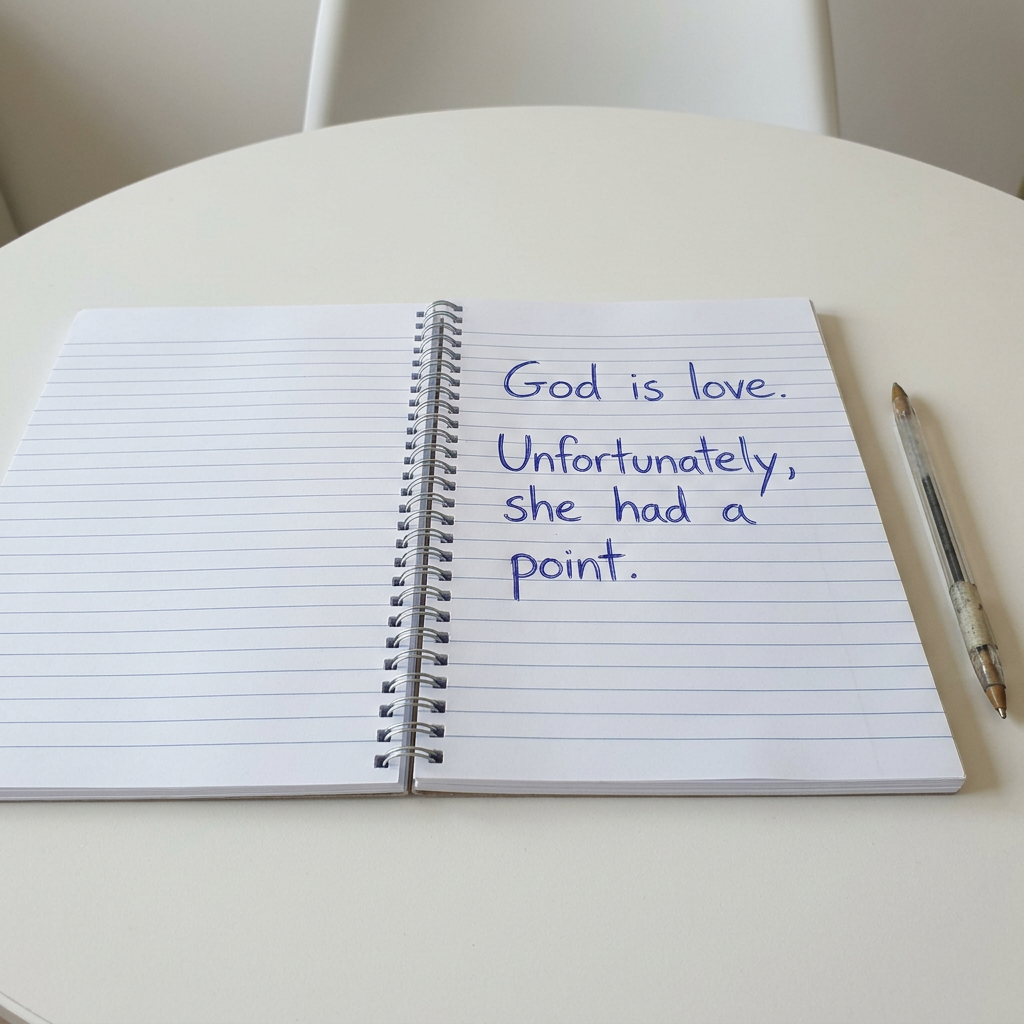
First, let me start by saying that I don’t plan on writing a blog about sermons at popular Black churches around Southern California forever, but right now I have the time and apparently I have opinions, so here we go. My husband really likes this particular church, which means I should probably begin with the disclaimer that I am not saying this pastor cannot preach. He can preach. He has energy, the congregation clearly loves him and at one point he jumped on the seat, so there was certainly no chance of me falling asleep. But when he announced that he was on part two of a four-part series on the Lord’s Prayer, I got excited. I pulled out my notebook because I thought we were about to really get into the history and meaning of one of the most recognizable prayers in Christianity. We didn’t even say the entire Lord’s Prayer! I don’t know, maybe I’m old-fashioned, but once the pastor starts climbing furniture, I expect us to arrive somewhere profound.
Fast-forward eight hours and I was putting my daughter to bed when she asked me how my day was and what I learned about in church. Man, how quickly children turn the questions you used to ask them back on you. I told her the sermon was about the Lord’s Prayer and she asked, “What’s that?” So I recited it to her the way I had been required to memorize it all those years ago: Our Father which art in heaven, Hallowed be thy name. Thy kingdom come, Thy will be done, on earth, as it is in heaven. Give us this day our daily bread. And forgive us our debts, as we forgive our debtors. And lead us not into temptation, but deliver us from evil: For thine is the kingdom, and the power, and the glory, for ever. Amen. King James Version, because yes, apparently that still matters to me. I like my Scripture the way I like an old hotel: beautiful, slightly formal and with absolutely no interest in modernizing for my convenience.
Something happened as I recited the Lord’s Prayer that I wasn’t expecting. I got chills and then this calm came over me. I hadn’t said the Lord’s Prayer in a very long time, but the words were still sitting there somewhere inside of me, perfectly intact, and saying them aloud felt familiar in a way I wasn’t prepared for. I had spent years thinking about the Lord’s Prayer as one of those things we were required to memorize and repeat in church without necessarily thinking about what we were saying, and yet here I was saying it to my daughter and feeling something. I wish I had had that moment in church earlier that day, but apparently the Lord decided I did not need the production lighting or a very enthusiastic man in surprisingly fitted pants pacing across a stage. I needed pajamas, an eight-year-old and a prayer I had known by heart for thirty years. Which, when you think about it, is rather on brand for Jesus.
Of course, my daughter wasn’t finished. She asked who said the prayer. Jesus. Then she asked why. Now this is where she made her mistake because I am not the mother who is going to say, “Because Jesus told us to,” kiss her forehead and turn off the light. Suddenly I also wanted to know exactly why Jesus taught this particular prayer, what was happening when he said it and why these specific words mattered. So there went my quiet after-bedtime routine. Instead of pouring something lovely and minding my business, I was researching first-century prayer practices and writing notes. In Matthew, Jesus teaches the prayer during the Sermon on the Mount after talking about people who had made prayer performative, praying publicly to be seen or using lots of words as though the length and grandeur of the prayer were what made God listen. Then Jesus gives his followers this remarkably short prayer. In Luke, the circumstances are slightly different because the disciples actually ask him to teach them how to pray, and even the wording of the prayer is different. Luke says “sins” where Matthew says “debts,” and “day by day” instead of “this day.” This is the kind of thing that fascinates me because I want to know why. I know there are people who can read two slightly different biblical accounts and simply keep going, but unfortunately I have never possessed that spiritual gift.
Then I discovered that the final line I had confidently recited to my daughter, “For thine is the kingdom, and the power, and the glory, for ever. Amen,” isn’t present in some of the earliest surviving manuscripts of Matthew. Well, now I was fully invested. The line, known as the doxology, became part of Christian prayer tradition and was included in the King James Bible, which explains why “Protestants” like me grew up saying it as though Jesus had clearly finished his prayer with a proper grand finale. Catholics handle it differently during Mass, separating the Lord’s Prayer from the doxology with another prayer in between. At this point my daughter had asked one innocent bedtime question and I was mentally somewhere between first-century Judea, seventeenth-century England and the Second Vatican Council. This is precisely why no one can ever figure out what kind of blog I write. One week we’re discussing cocktails and modern etiquette, the next I am investigating two thousand years of Christian liturgy at 8:30 pm on a Sunday night because an eight-year-old asked me one follow-up question. I would love to have a niche, but unfortunately my personality keeps getting in the way.
Back to the B-I-B-L- E, what interested me most, though, was understanding the Lord’s Prayer within the Jewish world Jesus lived in. Jesus was Jewish, his disciples were Jewish and the ideas in the prayer existed within a much older tradition of Jewish prayer. Honoring God’s name, praying for God’s kingdom, asking for provision and even addressing God as Father would not have sounded entirely new to his listeners, although they once sounded that way to me when I read the Bible without any of that context. The more I read, the more interesting the prayer became because Jesus seemed to be taking these enormous religious ideas and making them simple and intimate. There was no need to perform spirituality for an audience or impress God with an elaborate speech. Here was a prayer an ordinary person could remember and, perhaps more importantly for the woman lying next to an increasingly sleepy child, a prayer simple enough for a child to understand. For all the ways Christianity has managed to complicate itself over two thousand years and goodness, have we been committed to the project, the prayer itself remains remarkably uncomplicated.
That made me wonder if I should start saying the Lord’s Prayer with my children before bed. I have resisted things like that because I don’t want them memorizing religious language simply because I tell them to. I did enough of that as a child. I could recite things beautifully that I did not remotely understand, and when I did ask questions about the Bible, sometimes people treated the questions themselves as evidence that I didn’t believe enough. The problem was that I actually found the Bible fascinating. I wanted to know who these people were, why they were behaving this way, what was happening politically, why one Gospel told a story differently from another and why everyone around me seemed perfectly capable of reading some absolutely outrageous piece of biblical family drama and calmly moving on to the next verse. I would still be sitting there thinking, excuse me, are we not going to discuss what just happened? There are entire portions of the Old Testament with murder, incest, adultery, concubines, multiple wives and family feuds spanning generations, and everyone in Bible Study would just calmly turn the page. Meanwhile, I am sitting there thinking, “I’m sorry, his daughters did WHAT?” But apparently my follow-up question was the thing making everyone uncomfortable.
Maybe that is what has changed for me as an adult. I no longer feel like I have to pretend that curiosity and faith are opposites. I can read the Bible and also read about the history surrounding it. I can wonder why a translation uses one word instead of another. I can think something is beautiful and still have questions about it. I can hear a sermon, disagree with part of the interpretation, go home, research it myself and come away more interested in the Scripture than I was when I walked into church. Apparently nobody comes to your house and confiscates your Bible for this. Who knew? There is something luxurious about reaching an age where you no longer need every question to end with an approved answer. I can simply be curious, pour myself a cup of tea, or something stronger depending on which book of the Old Testament we’re in and keep reading.
So yes, I think I am going to teach my children the Lord’s Prayer, but I want to teach them what it means instead of simply teaching them the words. I want them to understand that when we say it, we are asking to honor what is sacred, hoping for a world filled with more goodness and justice, trusting that we will have what we need for today, asking forgiveness when we get things wrong and promising to extend that same grace to other people. We are asking for wisdom when we are tempted to do something we know we have absolutely no business doing and for protection from the things we cannot control. When I look at it that way, it is not simply an old prayer I was forced to memorize. It is actually a rather beautiful way to send a child to sleep and, frankly, a decent set of instructions for getting through adulthood.
The funny part is that when my daughter asked what I learned at church, I didn’t think I had a particularly good answer. By the time she fell asleep, I had one. I learned that the Lord’s Prayer means more to me now than it did when I was required to memorize it. I learned that perhaps the questions I was discouraged from asking as a child are exactly what make Scripture interesting to me as an adult. And I learned that I may actually enjoy going to church if I stop expecting the sermon to give me every answer and instead let it give me something interesting enough to come home and think about. Maybe I don’t need church to answer every theological question I have. Perhaps I simply need it to give me something worth discussing eight hours later while lying in bed with my daughter.
This is deeply unfortunate news for me because my husband has been trying to get me to go to church, and I refuse to give that man the satisfaction of knowing that this may be working. Marriage is built on love, mutual respect and occasionally withholding information that would make your spouse entirely too pleased with himself. So if you see him, mind your business.
As for me, I will apparently be back in a church near you on a Saturday or Sunday, notebook in hand, ready for my theological deep dive. I still have questions, I still expect a little more once we start climbing furniture, and I am increasingly fascinated by what happens when I go home and start looking for the answers myself.
Maybe I have finally found a reason to go back to church.
Please, nobody tell my husband.
Always Have, Always Will ~ Kalie



Leave a Reply