
My mother read my last blog post, The Exodus Before the Exodus, which, if you have been following along, was the one where I attempted to prove to her that although I have not been attending church with the consistency she would prefer, I am absolutely reading my Bible. I felt I had presented a fairly compelling defense. I had read 1 Chronicles. I had found Sheerah. I had checked the original Hebrew, wandered through ancient translations, somehow ended up in the Babylonian Talmud and followed a group of dead Ephraimites all the way into Ezekiel’s valley of dry bones. Frankly, I thought the level of effort alone deserved recognition. My mother did not disagree with my research. She did not challenge my Hebrew. She did not even object to the Seventh-day Adventist joke, which I had personally considered the portion most likely to get me removed from the family. Instead, I could hear that tiny note of disappointment in her voice that only a mother can produce while still sounding perfectly pleasant. She said, essentially, You are missing the point.
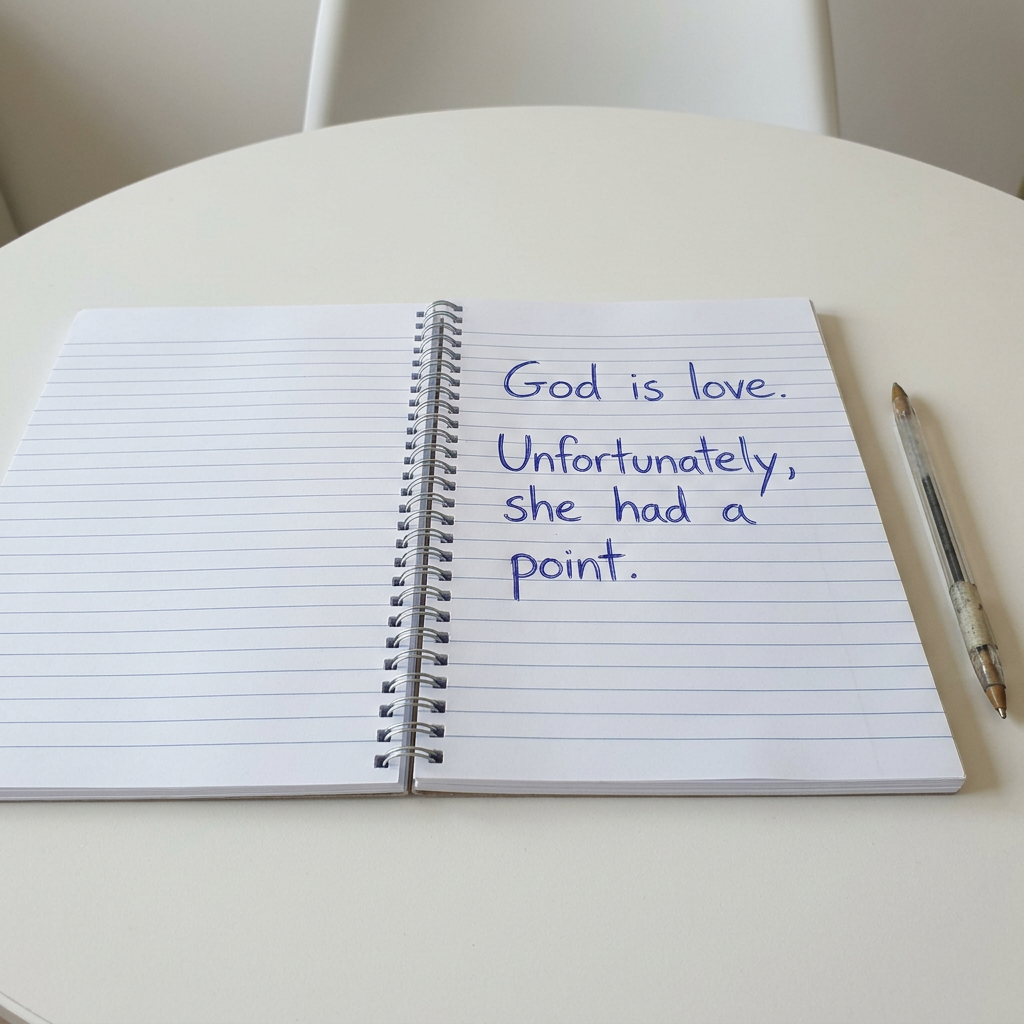
Apparently, I had managed to spend an unreasonable number of hours researching God without spending nearly enough time talking to God. This is, unfortunately, an extremely fair criticism of me. I like facts. I like history. I like pulling apart a story until I understand where everyone came from, what the original language says, whether the geography makes sense and who decided something seventeen centuries later that everyone now repeats as though it appeared in the King James Version. My mother, however, wanted me to try something different. She asked me to go back through the story from one premise: God is love. I admit this initially sounded suspiciously like an assignment, and I have not been in school for a very long time, but she is my mother and she read the entire article, so I decided she had earned the right to issue homework.
And annoyingly, Mom, you may have been onto something. Because when I went back, I stopped looking only at what the people in the story did and started looking at what God did. In the later Jewish tradition I had become so fascinated by, the Ephraimites believed God’s promise of deliverance, calculated the timing incorrectly, left Egypt early and died. I had read that as a spectacular warning about what happens when human beings receive a divine promise and immediately reach for a calendar. I still think that part is hilarious because I remain exactly the sort of person who could hear, Wait on the Lord, and respond, Of course, but approximately how long are we talking? I need to arrange childcare. But then I remembered where that strange tradition had led me: Ezekiel’s valley of dry bones. The people believe their hope is gone. Everything is finished. And God’s response is not a lecture about how they arrived there. God breathes life into what everyone else has already declared dead.
That changed Sheerah for me too. I had loved her because after death, grief and catastrophe, there she is in 1 Chronicles building cities. I saw myself in that instinct immediately. Something falls apart and eventually I want to know what we are going to do next, preferably with a spreadsheet, a budget and a reservation already confirmed. But perhaps I had made the builder the center of a story that was actually about what makes rebuilding possible. Maybe Sheerah’s building matters not because strong women heroically pull themselves together after terrible things happen, but because love refuses to let terrible things be the end of the story. There is grief, and then there is life. There are dry bones, and then there is breath. There is catastrophe, and then, somehow, there is still enough hope left for somebody to build a city.
So, Mom, I will concede this round. I still believe checking the Hebrew should count toward church attendance, and I reserve the right to appeal that matter separately. But perhaps God is love is not the simple answer I thought I already understood. Perhaps it is the thread I should have been looking for underneath all my research in the first place: the stubborn, extraordinary insistence that death, failure, grief and even our own spectacular miscalculations do not automatically get the final word. Sometimes love looks like resurrection. Sometimes it looks like restoration. And sometimes, many generations later, it looks like a woman named Sheerah picking up whatever survived and building something where there was once only loss. I think I understand now, Mom. Or at least I am beginning to.
Always Have, Always Will ~ Kalie




Leave a Reply